Updates
Oceanpoint Prepares Instant Liquidity for Income-Producing European Real Estate
Oceanpoint opens pre-launch discussions with institutional liquidity providers to support faster exits for tokenized, income-producing real estate.

New liquidity infrastructure is designed to connect stablecoin capital with tokenized real estate through a shared, real-yield liquidity layer
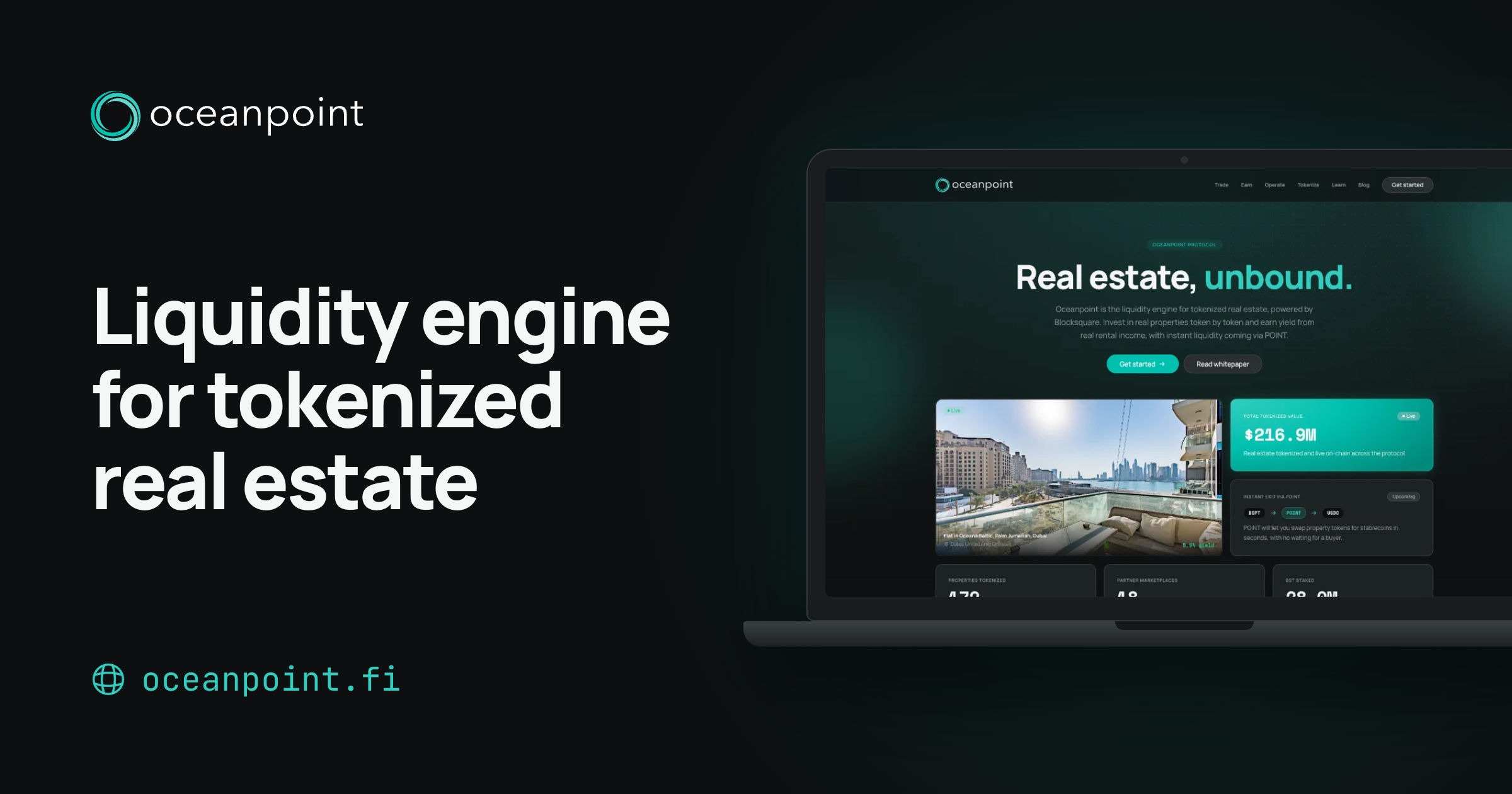
Oceanpoint is opening discussions with larger liquidity providers as it prepares for the initial launch of POINT—its liquidity engine for tokenized real estate.
Tokenization has made fractional property investment possible, but liquidity remains one of the sector’s biggest challenges. Property tokens are distributed across individual assets, marketplaces and jurisdictions, leaving liquidity fragmented and making efficient entry and exit difficult for investors.
The secondary market for eligible tokenized real estate is already active, but it remains fragmented and requires deeper, more efficient infrastructure.
POINT is being developed to address this structural gap.
Rather than operating as an actively managed real estate portfolio, POINT is designed as a shared liquidity and aggregation layer connecting stablecoin capital (USDC) with eligible tokenized real estate assets. Its purpose is to support deeper liquidity, more efficient property-token trading and broader access to income-producing real estate on-chain.
A potential $10 billion property pipeline
Through Oceanpoint’s wider partner network, approximately $10 billion in real estate assets has been identified as a potential future tokenisation pipeline.
Within that broader opportunity, approximately $500 million in properties could potentially be brought on-chain over the next six to twelve months, subject to asset suitability, legal structuring, due diligence, market conditions and successful onboarding.
This pipeline is intended to provide the real estate supply required to support POINT’s longer-term growth. Oceanpoint’s partner-led model connects property owners and marketplace operators with tokenization infrastructure, while POINT focuses on addressing the liquidity side of the market.
What liquidity providers may earn
Based on current launch assumptions, POINT modelling indicates an initial LP APY range of approximately 4.8% to 10%, with a median modelled scenario of 7.1%.
The model is designed to generate LP returns from the underlying real estate rather than inflationary token emissions. Potential LP returns may come from rental distributions generated by eligible property tokens held within the protocol and any property value appreciation realized when the underlying assets exit.
These figures are modelled scenarios rather than guaranteed returns. Actual performance will depend on treasury size, asset composition, property income, liquidity utilization, market conditions, fees and other risks.
Engaging with larger liquidity providers
Oceanpoint is currently open to discussions with larger liquidity providers interested in participating in the early development of POINT.
These discussions are intended for professional and institutional participants seeking exposure to emerging real-world asset infrastructure and interested in helping strengthen liquidity for tokenized real estate.
Prospective liquidity providers will be able to discuss:
- The proposed POINT liquidity structure;
- Launch-stage liquidity requirements;
- Modelled yield sources and risk considerations;
- Property pipeline and onboarding expectations;
- Participation terms and implementation timelines; and
- The relationship between POINT, property tokens and BST.
To learn more or begin a discussion with the Oceanpoint team, book a call or email future@blocksquare.io
Oceanpoint is currently open to engaging with larger LPs. Let’s connect.