Updates
Real Estate in 2027: You Have to Work for It. Here's Where Tokenization Fits
PwC and ULI say 2027 is the year real estate has to work for it. Here's what six key trends mean for owners and investors, and where property tokenization fits.
The Emerging Trends in Real Estate 2027 report from PwC and the Urban Land Institute says the era of easy, rate-driven returns is over. Owners now need new ways to raise equity, and investors need direct access to individual assets. Real estate tokenization addresses both, and Oceanpoint is a marketplace where owners can tokenize a single property without building their own platform.
Key takeaways- The 2027 edition is the 48th, based on roughly 500 interviews and close to 1,000 survey responses.
- Falling interest rates will no longer do the work. Value must come from income, management and execution.
- Debt maturities and fund redemption queues are pushing owners to look for capital beyond the bank.
- Investor demand is selective and asset-by-asset, especially in office conversions, infrastructure and fast-growing US cities.
- Tokenization lets an owner offer economic-rights tokens on one property to KYC-verified investors while keeping legal title.
- Blocksquare's infrastructure, which powers Oceanpoint, has supported more than $215 million in tokenized real estate across 30 countries and 19 marketplaces.
What does Emerging Trends in Real Estate 2027 say?
Each autumn, PwC and the Urban Land Institute publish the industry's most-watched outlook. Last year's mood was "navigating the fog." This year the fog has lifted, and the message is blunter.
"We're just going to have to work harder for it."
Interviewee quoted by Andrew Alperstein, PwC
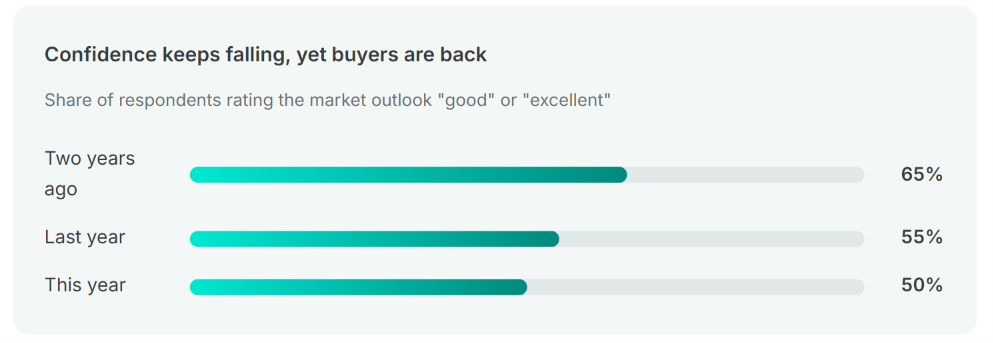
The data holds a paradox. Sentiment about business conditions fell again, yet "buy" ratings now outnumber "sell" and "hold." Investors are cautious about the market and keen on specific assets. That mix rewards anyone who can put one well-documented property in front of a buyer quickly and at low cost. That is what tokenization does.
Below are six of the report's trends and what each one means for property owners and investors.
Why does the end of cap rate compression matter for owners?
For a decade, falling rates lifted values on their own. Buy, wait, and watch the cap rate compress. Most respondents now expect rates to hold flat or rise slightly before easing.
That hits owners with debt coming due. Loan maturities, redemption queues and closed-end funds reaching the end of their lives are ending the "pretend and extend" habit. Some owners will have to sell into a soft market. Others will look for capital without giving up the building.
Tokenization gives them another lever. An owner can release part of the equity in one property by offering economic-rights tokens to verified investors, while keeping title and control. It does not replace a bank loan, and it cannot fix a building with weak fundamentals. It adds a capital option sized to the asset when other options are expensive.
How should investors approach the office comeback?
Office is back among the top three property types targeted by international institutional investors. The report describes "office curious" buyers picking up distressed or high-potential buildings and underwriting each one carefully.
Conversions are the clearest example. In Manhattan and Chicago, older office towers are becoming housing, but only once prices reset far enough for the numbers to work.
This demand is selective and building-specific. Investors want to see the figures behind one asset, not buy into a blind pool. On a tokenized marketplace, each property carries its own offering, documents and investor base. A conversion sponsor can raise from people who back that building, and those investors can see exactly what they own.
Why is transparency the edge in real estate infrastructure?
The report's line is that "infra is the new cyber." Managers are relabelling allocations as infrastructure, much as 1990s companies added "cyber" to their names. For the first time, infrastructure categories were ranked, and energy infrastructure, utilities and digital assets scored above every traditional property type.
Relabelling is easy. Proving what sits under the label is harder. A tokenized property records its corporate resolutions and ownership on-chain, so the link between token and asset can be checked rather than trusted. As capital chases anything branded infrastructure, verifiable records help genuine projects stand out.
What does "policy is the new geography" mean for tokenized property?
Institutional risk committees now assess political risk inside the United States. Rent control, zoning delays, data centre moratoriums and insurance costs shape returns more than city boundaries do. Tailwinds include extended Opportunity Zones, Low-Income Housing Tax Credits and the federal ROAD to Housing Act.
For tokenization, the legal structure cannot be an afterthought. Every Blocksquare deployment is built around local law. A licensed local marketplace operator handles onboarding and distribution, a property company holds title, and Blocksquare acts only as the technology provider. Blocksquare never holds investor funds. This separation lets each structure fit its jurisdiction.
Can tokenization help a generation priced out of property?
The report highlights the large cohort born around 1990. They are entering peak home-buying years, but the economy has split them into winners and those left behind.
Many earn well, invest digitally and still cannot afford a deposit where they work. A whole building is out of reach. A share of the income from a well-run building is not. Tokenization lowers the entry point without changing the asset, on the digital platforms this generation already uses.
Can investors outside the US access the top-ranked markets?
Dallas-Fort Worth is the number-one market to watch for a third straight year. San Francisco climbed 40 places on AI investment and rent growth. Columbus, Indianapolis and Chicago are rising on cheap land, labour and available power.
For most investors outside the US, buying into these markets directly is impractical. A tokenized property can be offered across borders to verified investors, within each jurisdiction's rules. That is how the model has reached 30 countries so far.
How does tokenizing a property on Oceanpoint work?
Oceanpoint is a marketplace for owners who want to tokenize a property without running their own platform. It is built on Blocksquare's tokenization infrastructure.
- The property company signs a notarised agreement with Blocksquare's Luxembourg entity.
- The Luxembourg entity issues property tokens to the owner.
- The owner offers economic-rights tokens to investors who have passed KYC checks.
- The property company keeps legal title throughout.
- A buyback obligation means tokens are repurchased when the property is eventually sold.
For investors, each listing stands alone. You choose the building, review its documents and track its net asset value as an ongoing price reference. The secondary market lets holders trade instead of waiting in a redemption queue, though no secondary market can guarantee a buyer at a given price.
Oceanpoint operates within the European MiCA framework and took part in the European Blockchain Sandbox in 2025.
The next ten years belong to those who build now
The report closes on a hopeful note: resets have historically set up a decade of growth for owners who manage actively and read demand clearly. The next decade will also be shaped by how real estate is financed and owned. Waiting for rate cuts is one strategy. Rebuilding how you raise and distribute capital is a better one.
Frequently asked questions
What is real estate tokenization?
Real estate tokenization turns economic rights in a property into digital tokens. Verified investors can buy those tokens, while the property company keeps legal title.
What is Emerging Trends in Real Estate 2027?
It is the 48th annual real estate outlook from PwC and the Urban Land Institute. It draws on about 500 interviews and nearly 1,000 survey responses from industry leaders.
What is Oceanpoint?
Oceanpoint is a real estate tokenization marketplace built on Blocksquare's infrastructure. Owners list individual properties, and KYC-verified investors buy economic-rights tokens in them.
Do property owners give up ownership when they tokenize on Oceanpoint?
No. The property company keeps legal title. Investors hold economic-rights tokens, and a buyback obligation applies when the property is sold.
Can I sell my property tokens before the property is sold?
Oceanpoint has a secondary market where holders can trade tokens. No secondary market can guarantee a buyer at a particular price.
Is Oceanpoint regulated?
Oceanpoint operates within the European MiCA framework and took part in the European Blockchain Sandbox in 2025.
Not investment advice. Tokenized real estate carries risk, including illiquidity and loss of capital.
Read more about tokenized real estate regulation in the EU